Archivio | 10/12/2025

★★。¸.☆☆Buonanotte¸.☆☆


pensieriang23

Esistenza – Existence


🌸Esistenza🌸

Esisto ancora
tra fruscio
di foglie
e carezza
di onde
Esiste
anche
il mondo
in briciole
di tempo
Esistiamo
in un tutto
ininterrotto
oltre le apparenze
sempre armonico

27.04.2019 Poetyca
🌸🌿🌸#Poetycamente
🌸Existence

I still exist
among rustling
of leaves
and caress
of waves
Exists
also
the world
in crumbs
of time
We exist
in a whole
uninterrupted
beyond appearances
always harmonious

27.04.2019 Poetyca

Metta Bhavana


meditare

Metta Bhavana
Il Mettā Bhāvanā è una forma di meditazione comune nel Buddhismo,soprattutto della scuola buddhista Theravada. La parola Mettā è una parola Pali che significa amore-gentilezza non condizionate. Questo tipo di meditazione è praticata con la consapevolezza (la coscienza) del respiro, che dà concentrazione, con lo scopo di prevenire la perdita della compassione.La meditazione mettā bhāvanā significa coltivazione del mettā.
L’oggetto della meditazione mettā è sviluppare benevolenza e compassione verso tutti gli esseri senzienti. I sei passi del mettā bhāvanā sono coltivare amore e benevolenza verso:
1-Se stessi
2-Un buon amico
3-Una persona neutrale
4-Una persona difficile
5-Tutti quattro i precedenti
6-Gradualmente, l’intero universo
La pratica, come viene insegnata nel Buddhismo Theravada, solitamente inizia con la coltivazione della compassione e dell’amore per se stessi, poi per le persone amate, gli amici, maestri, stranieri ed infine per i nemici. E’un buon metodo per calmare la mente, oltre che un “antidoto” all’ira. Chi sviluppa il mettā difficilmente sarà turbabile e potrà sopprimere la rabbia sul nascere. Tali persone saranno più attente verso gli altri, più disposte a voler bene ed amare, e più inclini ad amare incondizionatamente.( (Kamalashila 1996, p.25-26).
I Buddhisti credono che le persone che hanno molto mettā saranno più felici poiché non vedranno motivi per volere il male di qualcuno. I maestri buddhisti possono raccomandare la meditazione sul mettā come antidoto all’insonnia e agli incubi. È comunemente sentito che coloro i quali sono intorno ad una persona che ha sviluppato il mettā si sentono a loro agio e più felici. L’emanazione del mettā contribuisce ad un mondo pacifico, d’amore e felicità.
Nel Buddhismo, la compassione è il vissuto del desiderio del bene nei confronti di ogni essere senziente. Esso viene indicato con i due termini sanscriti di:

karuṇā (pāli: karuṇā) nel significato di “pietà”, “misericordia”, “vissuto di dolorosa empatia” reso in lingua cinese come 悲 bēi, in giapponese hi, in tibetano snying rje;
maitrī (pāli: mettā) nel significato di “amore”, “benevolenza”, “carità”, reso in lingua cinese come 慈 cí, in giapponese ji, in tibetano byams pa.

· Nel Buddhismo Mahāyāna la “compassione” (karuṇā) rappresenta unitamente alla “saggezza” (prajñā) i due pilastri delle proprie dottrine e pratiche religiose.
· La dottrina e la pratica mahāyāna della “compassione” si fondano sulla consapevolezza (saggezza, sans. prajñā) della “Verità della Via mezzo” (sanscrito mādhya-satya) predicata da Nāgārjuna ovvero sulla compresenza della “assolutezza” (paramārtha-satya) o vacuità (śūnyatā-satya) e della “singolarità” o “provvisorietà” (saṃvṛti-satya) in ogni aspetto della Realtà ultima per cui essendo “Tutto” privo di esistenza intrinseca, indipendente, ogni fenomeno esiste sia nella sua natura soggettiva (“convenzionale”) e contemporaneamente nella sua relazione con gli altri (“assoluta”) rappresentando la “singolarità” una delle molteplici manifestazioni di un’unica Realtà ultima: singole facce di un «grande brillante». Le distinzioni che la mente opera di continuo, unicamente dividendo e classificando in categorie le percezioni, sono viste, dunque, come illusorie e l’ego se non compreso anche olisticamente con l’intera Realtà è solo un’illusione poiché non esiste un io separato da tutto il resto.
· Per questa ragione il Buddhismo Mahāyāna non predica il “distacco” nei confronti dei sentimenti e dei vissuti quale l’amore e la pietà, ma fonda la sussistenza di ciò sulla corretta comprensione della Realtà ultima (saggezza, sans. prajñā).
· Quindi non vi può essere “compassione senza saggezza”, né “saggezza priva di compassione”.
· Nel Buddhismo Mahāyāna il principio della “compassione” è rappresentato dal bodhisattva cosmico Avalokiteśvara.
· (da Wikipedia).

Metta Bhavana

The metta bhavana is a common form of meditation in Buddhism, especially Theravada Buddhist School. The word Mettā is a Pali word meaning loving-kindness unconditional. This type of meditation is practiced with awareness (consciousness) of the breath, which gives concentration, in order to prevent the loss of compassione.La Metta Bhavana meditation means cultivation of metta.
The object of metta meditation is to develop goodwill and compassion for all sentient beings. The six steps of Metta Bhavana are cultivating love and benevolence towards:
        1-Themselves
        2-A good friend
        3-A neutral
        4-A difficult person
        All four of the previous five-
        6-Gradually, the entire universe
The practice, as taught in Theravada Buddhism, usually begins with the cultivation of compassion and love for yourself, then for your loved ones, friends, teachers, and finally to foreign enemies. It is a good way to calm the mind, as well as an “antidote” to anger. Who develops metta will hardly be turbabile and can suppress the anger in the bud. These people will be more attentive to others, more willing to love and love, and more inclined to love unconditionally. ((Kamalashila 1996, p.25-26).
Buddhists believe that people who have very metta will be happier because they will not see reasons to want evil to anyone. Buddhist teachers may recommend meditation on metta as an antidote to insomnia and nightmares. It is commonly heard that those who are around a person who has developed metta feel at ease and happier. The enactment of metta contributes to world peace, love and happiness.
In Buddhism, compassion is the experience of desire for good against every sentient being. It is indicated by the two Sanskrit terms of:

    Karuna (Pali: Karuna) in the meaning of “mercy”, “compassion”, “painful experience of empathy” rendered in Chinese as 悲 EIB, in Japanese hi, snying rje in Tibetan;
    Maitri (Pali: metta) in the meaning of “love”, “benevolence”, “charity”, rendered in Chinese as 慈 cí, in Japanese ji, in Tibetan byams pa.

· In Mahayana Buddhism “compassion” (Karuna) is combined with the “wisdom” (prajna) the two pillars of its religious doctrines and practices.
· The doctrine and practice of Mahayana “compassion” are based on the awareness (wisdom, sans. Prajna) of “Truth of the Way middle” (Sanskrit Madhya-satya) preached by Nāgārjuna or on the presence of “absoluteness” (paramartha-satya) or emptiness (śūnyatā-satya) and “singularity” or “provisional” (saṃvṛti-satya) in every aspect of the ultimate Reality that being “Everything” devoid of inherent existence, independent, every phenomenon exists both in its subjective nature (” conventional “) and at the same time in his relationship with others (” absolute “) representing the” singularity “one of the many manifestations of a single ultimate reality: individual faces a” big bright. ” The distinctions that the mind works continuously, only dividing and classifying them into categories perceptions, are seen, therefore, as illusory and ego if not covered even holistically with the whole Reality is merely an illusion because there is no separate self from everything else.
· For this reason Mahayana Buddhism does not preach the “gap” towards the feelings and experiences as love and compassion, but bases the existence of what the correct understanding of the ultimate Reality (wisdom, sans. Prajna).
· So there can be “compassion without wisdom”, or “wisdom without compassion.”
· In Mahayana Buddhism the principle of “compassion” is represented by the bodhisattva cosmic Avalokiteśvara.
· (From Wikipedia).

Eroi o viaggiatori


242557_10150197771564646_742844645_7291616_5903816_o

Eroi o viaggiatori

Infinito è il nostro Essere
passo dopo passo
in bilico tra illusioni e false idee
sino a quando uno squarcio
della nostra mente
interrompe il percorso
per riallacciare respiro e battito
in quello spazio senza spazio
dove il tempo non è tempo
rarefatto slancio
oltre tutte le apparenze
Eroi o viaggiatori
percorrono a ritroso
quel viaggio infinito
che è senso del nostro vagare

30.05.2015 Poetyca

Heroes or travelers

Infinity is our Being
step by step
hovering between illusions and false ideas
as long as a gash
of our mind
stop the route
to renew breath and heartbeat
in that space without space
where time is not time
rarefied impetus
beyond all appearances
Heroes or travelers
run through backwards
that endless journey
that is our sense of wandering

05/30/2015 Poetyca

Visioni


Visioni
Attimi e visioni
senza più tempo
i n e b r i a n d o s i
oltre la memoria
dove le ali conducono
dove il suono del cuore
ripete la stessa musica
– una coperta di gioia –
ed in questo attimo
socchiudendo gli occhi
vivo quel che è
palpito e sospiro
di un anima libera

06.01.2008 Poetyca
Visions
Moments and visions
no longer
i n e b r i a t e
beyond the memory
where the wing leading
where the sound of the heart
repeats the same music
– A blanket of joy –
and in this moment
squinting
what is alive
throb and sigh
a free soul

06.01.2008 Poetyca

La carezza del vento – The Caresses of the wind


LA POESIA DELLA SETTIMANA

LA CAREZZA DEL VENTO

di Daniela Poetyca

Dany è nata a Roma, ma risiede a Reggio Calabria dal 1968. Scrive componimenti poetici dall’età di 12 anni. E’ portata al dialogo e all’ascolto di se stessa e degli altri, ama la natura e «sentire» le proprie emozioni. Ama la lettura e la riflessione.

Scrivere è condividere con gli altri il suo animo. Considera che ognuno di noi ha la Luce interiore, ma va cercata. E’ sempre alla ricerca di un evoluzione interiore che porta alla propria autocoscienza.

Ha molto entusiasmo in tutte le cose che intraprende e crede in quello che ama.

Attraverso internet ha una vasta rete di contatti che le consentono di ascoltare la vita degli altri spesso fonte d’ispirazione per le poesie.

Il mondo poetico oggi ha perduto la sua singolarità, è rimasta soltanto la tematica che è di un’enorme vastità e non impone una severa meditazione; soprattutto per evitare il rischio di dilungarsi e di evadere dall’argomento. Quando parla di affetti umani, subito il pensiero corre alla famiglia, al vincolo naturale che lega il marito alla moglie, i figli ai genitori e viceversa, i fratelli ai fratelli. Credo che intorno a ciò non ci siano dispareri e che tutti quanti considerino l’affetto familiare come fondamentale per la società umana. C’è poi l’affetto dell’uomo per l’uomo. Il Cristianesimo dice: «Amerai il prossimo tuo come te stesso».

Appunto perché gli affetti esistono in noi, vivi, eterni e indistruttibili, possiamo affermare che l’origine altissima dell’uomo è l’essere fatto ad immagine e somiglianza di Dio. Non fa quindi meraviglia che tali sentimenti abbiano trovato nei poeti la loro più genuina ed efficace espressione. Una delle nostre prime letture scolastiche fu quella dell’Iliade e noi tutti ricordiamo i personaggi di Ettore, Andromaca ed Astianatte che Omero ha eternato nel famoso incontro descritto nel libro VI. Si tratta di parole scritte 2900 anni fa e che sembrano di oggi, perché anche oggi conservano la loro efficacia, e i padri, le madri e i figli d’oggi nutrono gli stessi sentimenti delle famiglie dell’antica Grecia e di Roma. La stessa osservazione si può fare, ricordando l’incontro di Ulisse col figlio Telemaco, dello stesso eroe con la moglie Penelope e col padre Laerte e, giungiamo, con la madre Anticlea la quale, ormai negli Inferi, risveglia in lui la più profonda tenerezza.

Il sentimento per il volo di «chi è nato per il cielo» ha trovato in questa lirica la sua più alta espressione, tanto da riportare alla memoria Virgilio di cui si possono ricordare le «alate parole con le quali celebrò la grandezza e la missione di Roma: Tu, o Romano, ricordati di reggere col tuo comando i popoli, di dare a tutti l’ordine e le leggi, di risparmiare quelli che obbediscono e di debellare i superbi».

Credo che bastino questi pochi esempi per capire, leggendo tra le righe e scavare nell’anima di Dany Poetyca ci ha portato, indubbiamente, a considerare e riflettere sulla sua interpretazione del sentimento umano, con ardore ed efficacia.

Spesso il maggior nemico da superare, non è la natura del suolo o l’avversità delle condizioni climatiche, ma l’ignoranza cui («non fugge mai il silenzio»). Anche se l’affermazione potrà sembrare strana il numero degli analfabeti è ancora molto elevato in vastissimi paesi, comunemente denominati «in via di sviluppo». A questi popoli dovrebbe giungere il monito della nostra autrice: «ogni attimo è un seme».

Ecco le efficacissime armi per la lotta contro la fame, la rivalutazione della dignità del lavoro; in modo che aggrappandosi all’immagine del Gabbiano in volo anch’essi lo potranno fare, sorvolando le vaste zone dei paesi africani ed asiatici, dove gran parte della popolazione maschile ritiene che il lavoro abbassi la dignità dell’uomo e «aspetta che il vento gli accarezzi le piume» intanto lascia alle donne il compito di lavorare.

LA CAREZZA DEL VENTO

di Dany Paetyca

Non abbandona mai il volo

chi è nato per il cielo:

Apre le ali

e cerca le sue rotte.

Non scioglie il coraggio

chi ha visto “oltre”:

stringe i denti e lotta.

Non stringe mai il pugno

in segno di rabbia

chi ha il cuore sereno.

Non fugge mai il silenzio

chi è in ricerca:

ogni attimo è un seme.

Non abbandona le lacrime

chi ha il cuore sensibile

e lava al mondo tutte le pene.

Ama e tace chi sogna

aspetta che il vento

gli accarezzi le piume.

Vola ancora gabbiano

perché sei sempre

figlio del cielo.

*************************

Un forte abbraccio circolare e l’augurio che il sole sia sempre più caldo e sincero come il tuo cuore desidera, Reno Bromuro

9 Aprile 2005

Il Baricentro Mensile di critica artistica e letteraria

THE POETRY OF THE WEEK

THE CARESS OF THE WIND

Daniela Poetyca

Dany was born in Rome, but residing in Reggio Calabria in 1968. He wrote poems from the age of 12 years. And ‘capacity to dialogue and listening to herself and others, love nature and “feel” their emotions. She loves reading and reflection.

To write is to share with others her feelings. Consider that each of us has an inner light, but must be sought. It ‘s always in search of an inner evolution that leads to self-consciousness.

He has a lot of enthusiasm in everything he undertakes and believes in what he loves.

Through the Internet has a vast network of contacts that you can listen to the lives of others is often a source of inspiration for the poems.

The poetic world today has lost its uniqueness, has remained the only issue that is of enormous size and does not impose a strict meditation, mainly to avoid the risk of escape and dwell on the topic. When he talks about human emotions, thoughts turn immediately to the family, the natural bond that binds the husband to his wife, children against parents and vice versa, brothers to brothers. I think about what we are dispareri and consider all of the affected family as fundamental to human society. Then there is the love of man for man. Christianity says: “You shall love your neighbor as yourself.”

Just because there are affections in us, the living, eternal and indestructible, we can say that the origin of man is the highest to be made in the image and likeness of God is not surprising that these sentiments in the poets have found their most genuine and effective expression. One of our first school was reading the Iliad and we all remember the characters of Hector, Andromache and Astyanax, which Homer immortalized in the famous encounter described in Book VI. These are words written 2900 years ago and seem today, because even today retain their effectiveness, and the fathers, mothers and children today eat the same feelings of families of ancient Greece and Rome. The same observation can be done, remembering the encounter of Odysseus with his son Telemachus, the hero himself with his wife Penelope and his father Laertes, and we arrive, with his mother Anticlea which, now in the Underworld, he awakens the deepest tenderness .

The feeling for the flight of “who is born for heaven,” he found in this opera to its highest expression, so as to bring the memory of Virgil which you may remember the “winged words with which he celebrated the greatness and mission Rome: Thou, O Roman, remember to hold your command with the people, to give all the order and laws, save those who obey and to eradicate the proud. “

I think these few examples suffice to understand, reading between the lines and dig into the soul of Dany Poetyca has brought us, no doubt, to consider and reflect on its interpretation of human feeling, with enthusiasm and effectiveness.

Often the greatest enemy to overcome, not the nature of the soil or climatic conditions of adversity, but the ignorance of which (“never flees the silence”). Although the statement may seem odd number of illiterate people is still very high in the vast country, commonly referred to as “developing.” These people should get the warning of our author, “every moment is a seed.”

These are very effective weapons in the fight against hunger, the appreciation of the dignity of labor, so that by clinging to the image of Seagull in flight also they will do it, flying over the vast areas of countries in Africa and Asia, where most of the male population believes that the work lowers the dignity of man and “wait for the wind caress the feathers” while leaving the task of working women.

THE CARESS OF THE WIND

Dany Paetyca

It never leaves the flight

who is born for heaven:

Spreads its wings

and seeks its routes.

Do not melt the courage

who has seen “over”:

grits his teeth and fight.

Do not tighten the fist

as a sign of anger

who has the serene heart.

Never flees the silence

those in search:

every moment is a seed.

Do not leave the tears

who has a sensitive heart

and washes all the troubles in the world.

He loves and is silent dreamer

expect that the wind

stroked his feathers.

Seagull still Fly

why are you always

son of heaven.

*************************

A strong move and embrace the hope that the sun is warm and sincere as ever your heart desires, Reno Bromuro

April 9, 2005

The center of gravity Monthly art criticism and literary

cღPoeti amici ღ★


Vita – Life


🌸Vita🌸

Ed è viaggio
oltre ogni confine
spezzando
le catene
del tempo

Ed è sasso
che rotola
dall’altipiano
verso la collina
spinto dal vento

Ed è nuvola
al di sopra
di tutto
nata da gocce
di mare

Ed è forza
tra speranze
e informi sagome
d’impalpabile
illusione

È chiedersi sempre
“Io chi sono?”
cadendo e rialzandosi
ogni volta
senza mai temere

È adesso
oltre tutte le parole
in questa
sublime emozione
“É vita!”

26.05.2018 Poetyca
🌸🍃🌸
🌸Life

And it’s a journey
beyond every boundary
breaking
the chains
of time

And it is stone
that rolls
form mountain
towards the hill
pushed by the wind

And it’s a cloud
above
of everything
born of drops
of sea

And it is strength
between hopes
and inform shapes
impalpable
illusion

It is always asking yourself
“Who am I?”
falling and getting up
whenever
without ever fearing

And it is now
beyond all words
in this
sublime emotion
“It’s life!”

May 26, 2018 Poetyca

cღPoeti amici ღ★


Ricerca – Search – Haiku


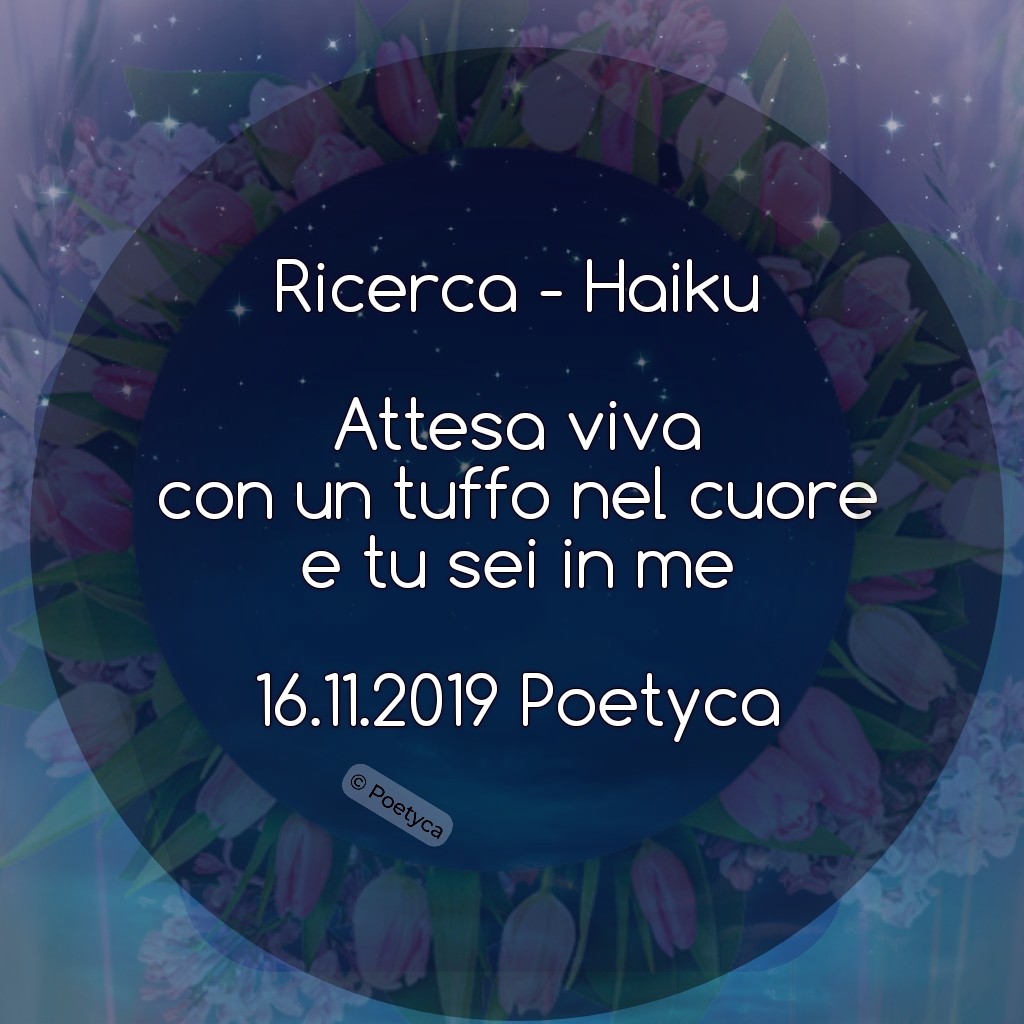
💮Ricerca – Haiku💮

Attesa viva
con un tuffo nel cuore
e tu sei in me

16.11.2019 Poetyca
💮🌿💮#Poetycamente
💮Research – Haiku

Waiting alive
with a dip in the heart
and you are in me

16.11.2019 Poetyca

Guido – Acrostico


Aiuto – Help – George Ivanovich Gurdjieff


🌸Aiuto🌸

“Aiuta l’altro
ad aiutare se stesso.”

George Ivanovitch Gurdjieff
🌸🌿🌸 ##pensierieparole
🌸Help

Help others
to help themselves.”

George Ivanovitch Gurdjieff

Favola – Fable


🌸Favola 🌸

Favola viva
e colori d’incanto
per chi muove
i propri passi
in una realtà
difficile da accettare
ed è sogno e suono
a regalare nuove ali
per superare oggi
ogni ostacolo

25.05.2024 Poetyca
🌸🌿🌸 ##Poetycamente
🌸Fable

Living fairy tale
and enchanting colours
for those who move
your own steps
in a reality
difficult to accept
and it is dream and sound
to give new wings
to get through today
every obstacle

Poesia – Poetry


🌸Poesia🌸

Armonia e Bellezza,
compagne di viaggio
che respirano poesia.

25.05.2024 Poetyca
🌸🌿🌸 ##Poetycamente
🌸Poetry

Harmony and Beauty,
travel companions
that breathe poetry.

05.25.2024 Poetyca

cღPoeti amici ღ★


cღPoeti amici ღ★


Una perla al giorno – Plotino, Enneade


mandala13
Il nostro generale istinto di cercare e di imparare
ci spingerà, com’è ragionevole, a indagare
nella natura dello strumento che usiamo per ricercare.

Plotino, Enneade IV, 3, 1
Our general instinct to seek and to learn
it moves us, it is reasonable to investigate
in the nature of the instrument that we use for research.

                 Plotinus, Ennead IV, 3, 1